
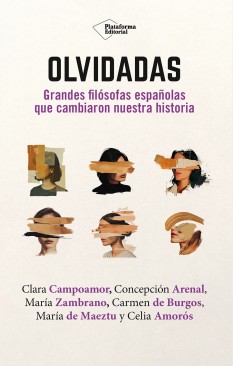
Olvidadas : Grandes filósofas españolas que cambiaron nuestra historia
by VV.AA.
$ 22.95
The history of thought in Spain owes a debt to women. "Forgotten" was born to redress this injustice and combat the systematic exclusion suffered by female thinkers in both the philosophical canon and educational textbooks. Through a journey spanning more than a century, this collaborative work constructs a solid genealogy of feminism and social philosophy in Spain, analyzing the thought and practice of six essential intellectuals.
The book begins in the turbulent 19th century with Concepción Arenal, a pioneer with a profound social conscience. Against the biological determinism and misogyny of her time, Arenal demonstrated that the supposed inferiority of women was a result of a lack of education. Furthermore, she revolutionized penitentiary law (breaking away from Lombroso's positivism) by advocating for the education and rehabilitation of prisoners as opposed to mere punishment, and by analyzing the intersectional vulnerability of working-class women and prisoners.
The book then delves into the 20th century with Carmen de Burgos, "Colombine." A freethinker, journalist, and Spain's first female war correspondent, she embodied the modern woman, putting theory into political action. From her tireless campaigns for divorce legislation to her seminal essay, *The Modern Woman and Her Rights* (1927), Burgos was a beacon of Spanish feminism and a staunch anti-war activist.
The formative pillar is represented by María de Maeztu, who conceived of education as the true instrument of freedom. Her creation of the Residencia de Señoritas (Residence for Young Women) and the Lyceum Club Femenino (Women's Lyceum Club) forged unprecedented spaces for intellectual development and the creation of women's networks; a brilliant and cosmopolitan project tragically cut short by the outbreak of the Spanish Civil War, plunging her into exile and isolation.
In the political sphere, the book reconstructs the titanic parliamentary struggle of Clara Campoamor. Her defense of women's suffrage in the 1931 Constitution, achieved despite the prejudices, educational excuses, and fears of her own Republican side, enshrined true political citizenship for Spanish women. A democratic and ethical triumph—her self-proclaimed "mortal sin"—that ultimately cost her political ostracism and permanent exile.
The purely philosophical milestone arrives with María Zambrano. A thinker rooted in exile for over forty years, Zambrano transcended the strict rationalism of her teachers to forge "poetic reason." Her approach embraces vulnerability, piety, and mysticism, demonstrating that the convergence of poetry and philosophy is the indispensable path to rescuing the individual from the crisis, violence, and totalitarianism of the West.
Finally, the volume enters the contemporary era with Celia Amorós, an undeniable driving force behind contemporary philosophical feminism. With profound ontological rigor, Amorós unmasks the patriarchal reason of the Enlightenment, providing feminism with key theoretical categories. She denounces how men historically established themselves as individuals ("the equals"), relegating women to a natural, undifferentiated, and interchangeable essence ("the identical ones"), thus constructing a powerful critical theory indispensable for sociopolitical emancipation.
Ultimately, "Forgotten Women" is not merely a biographical compendium, but an intellectual and civic vindication. It demonstrates how these thinkers united theory and activism to dismantle structures of oppression, leaving a peaceful, reformist, and revolutionary legacy that, given the current global context, is absolutely essential.
AUTHORS
PUBLISHER
RELEASE DATE
September 23, 2026
ISBN
9791388080869
PAGES
168 p. ; 22,0 x 14,0 cm.
BINDING
Paperback
SERIES
LANGUAGE
Spanish