
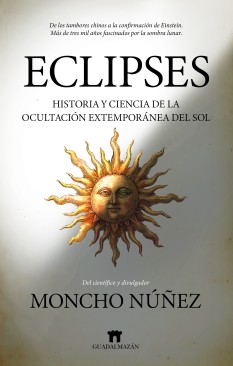
Eclipses : Historia y ciencia de la ocultación extemporánea del Sol
by Moncho Núñez
$ 17.45
Why were astrologers in China beheaded for failing to predict an eclipse? How does the Saros cycle, discovered by the Babylonians, work? Why does a total eclipse take 375 years to repeat itself in the same location? What was the Antikythera Mechanism, and what was the purpose of its thirty gears? How did an eclipse confirm Einstein's general theory of relativity? Why do animals become disoriented when the sky darkens in the middle of the day? Is it a coincidence that the Moon and the Sun now appear to be the same size? What did 19th-century astronomers discover by photographing the solar corona? This book is for those seeking to understand how we went from superstitious terror to precise mathematical calculation, thanks to a phenomenon that lasts only a few minutes and has, in many ways, shaped the history of science. Eclipses documents more than three thousand years of human history in the face of the Sun's disappearance: from Aztec sacrifices of albino people and Chinese drums to the scientific expeditions that chased the lunar shadow across the globe. Moncho Núñez combines astronomy (orbital geometry, periodicities, measurable physical effects) with verifiable historical episodes: clay tablets, the Mayan Dresden Codex, Eddington's reports on Príncipe Island and even the donkey that brayed in Plasencia during the totality of the 1900 eclipse.
AUTHORS
PUBLISHER
RELEASE DATE
January 20, 2026
ISBN
9791387941055
PAGES
192 p. ; 20,0 x 12,5 cm.
BINDING
Paperback
SERIES
Divulgación Científica
LANGUAGE
Spanish